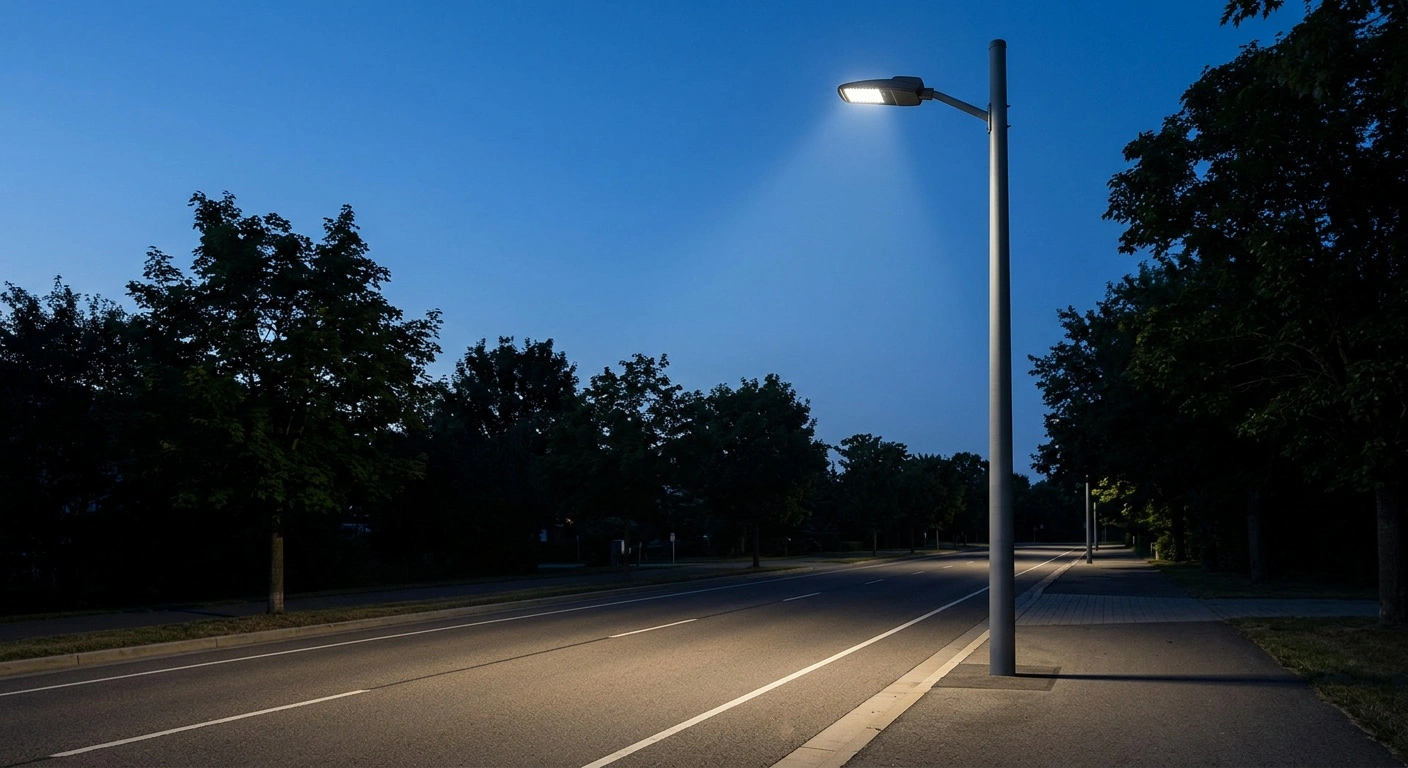
The modern LED street light has evolved from an energy-saving replacement for high-pressure sodium into a controllable outdoor lighting platform. Still, efficiency alone does not create a good roadway installation. Optics, glare control, color temperature, surge protection, thermal design, and network security all affect performance.
Current products can deliver precise roadway distributions, automatic dimming, fault reporting, and substantial energy savings. Poorly selected fixtures, however, can produce harsh glare, excessive uplight, uneven illumination, and more light than the road needs. Utilities and municipalities should evaluate delivered pavement light instead of replacing fixtures based on wattage alone.
Roadway-lighting criteria, electrical codes, environmental rules, and local ordinances must guide the final design. A licensed electrician or qualified utility crew should handle pole wiring, junction boxes, new circuits, and line-voltage service work.
How LED Street Lighting Evolved
Older roadway systems used replaceable lamps, reflectors, ballasts, and standardized fixture housings. Mercury-vapor lamps gave way to high-pressure sodium in many areas because sodium systems produced more light per watt and lasted longer. Their amber output supported basic roadway visibility, but it provided poor color identification.
High-pressure sodium lamps also required warm-up and restrike time. Their large lamps and reflectors limited optical control. Metal-halide systems provided whiter light and better color rendering, although maintenance and lamp depreciation remained significant.
Modern LED luminaires replace the arc tube and reflector with directional emitters, secondary lenses, a driver, and a heat sink. Most also include a sealed optical compartment. This construction gives designers more control over both light and heat.
The development of practical blue LEDs marked a major technical step. Manufacturers combined blue emitters with phosphors to produce efficient white light. Early outdoor products proved that solid-state sources could handle roadway service, but many had high prices, cool color temperatures, and visible pixel glare.
Current luminaires use improved phosphors, efficient drivers, silicone optics, and carefully designed thermal paths. Individual lenses direct light toward the roadway instead of relying mainly on a large reflector. As a result, less light reaches bedroom windows, areas behind the pole, or the sky.
What Makes a Modern LED Street Light Efficient
Luminaire efficacy, measured in lumens per watt, provides a useful starting point. However, it does not show where the light lands. A highly efficient fixture with the wrong distribution may require closer pole spacing or higher output.
Current roadway luminaires often deliver about 100 to 170 lumens per watt. Color temperature, drive current, optics, controls, and ambient-temperature ratings can change that figure. This range describes the product category, not every available fixture.
Project teams should review the submitted photometric file and model the actual layout. Those steps reveal more than a headline efficacy number.
| Metric | What it measures | What it means in practice |
|---|---|---|
| Lumens | Total light output | Use lumens to compare output. Watts measure electricity use, not brightness. |
| Lumens per watt | Fixture-level efficacy | A higher value generally helps if the beam pattern and glare remain suitable. |
| Illuminance | Light reaching a surface, measured in lux or foot-candles | This value shows how much light reaches the roadway, sidewalk, or intersection. |
| Uniformity ratio | The relationship between average and minimum illumination | Poor uniformity creates dark gaps even when the average level appears adequate. |
| BUG rating | Backlight, uplight, and glare distribution | This rating identifies light emitted behind the pole, above horizontal, or at high glare angles. |
| L70 | Projected time until output declines to 70% of initial light | This projection describes lumen maintenance under stated conditions, not guaranteed service life. |
| Power factor | How effectively the driver uses supplied AC power | A high power factor limits unnecessary current in utility and commercial systems. |
Roadway designers usually work with maintained illuminance or luminance, uniformity, glare, roadway classification, and pedestrian activity. They also account for conflict areas such as intersections. The Illuminating Engineering Society publishes guidance, while transportation agencies and local authorities may set additional requirements.
Designers should model each fixture at the actual mounting height, arm length, tilt, pole spacing, and pavement type. They should use a manufacturer-supplied photometric file. The calculation must also account for dirt accumulation and expected lumen depreciation.
The efficient choice is usually the lowest-wattage luminaire that meets maintained design criteria. The lowest-wattage product in a catalog may not provide safe or uniform coverage.
Optics, Mounting Height, and Visual Comfort
LEDs emit directional light, which gives roadway luminaires tighter control than large discharge lamps. Manufacturers offer distributions for residential streets, arterials, intersections, sidewalks, parking areas, and long pole spacing. The correct optic depends on road width, setback, mounting height, mast-arm geometry, and pole arrangement.
A higher mounting position can improve coverage and uniformity. It may also require more output and send light farther beyond the target area. Tilting a fixture upward extends its reach but often increases glare, high-angle light, and uplight.
Glare causes many complaints after LED conversions. Small, intense emitters can create discomfort even when pavement readings meet the target. Diffusers may reduce visible intensity, but they can also weaken beam control and lower optical efficiency.
Better remedies include proper shielding, low-glare optics, suitable pole spacing, and restrained output. The IES Backlight-Uplight-Glare system helps teams compare light distribution. Acceptable BUG ratings still depend on the site and its environmental zone.
Low uplight helps protect the night sky, but it does not automatically prevent glare toward drivers or nearby homes. A nighttime mock-up on an installed pole often reveals problems that indoor product reviews miss.
Color Temperature and Color Quality
Early roadway projects often used cool-white sources because they offered high efficacy. Many agencies now specify warmer light to reduce visual harshness and short-wavelength output. Correlated color temperature describes the appearance of nominally white light, not its brightness.
A 3000K luminaire appears warmer than a 4000K model, while 5000K appears distinctly cooler. Products with the same Kelvin rating can still differ in spectral distribution, color rendering, and tint. Roadway type, pedestrian activity, surrounding land use, wildlife, and local rules should guide the choice.
| Nominal CCT | Visual appearance | Common design consideration |
|---|---|---|
| 2200K to 2700K | Amber to very warm white | Useful where limiting short-wavelength light matters. Some products provide lower efficacy or reduced color discrimination. |
| 3000K | Warm white | A common choice for residential streets, pedestrian areas, and communities seeking less blue-white light. |
| 3500K to 4000K | Neutral white | Often used on busier roads where color recognition and visual contrast carry more weight. |
| 5000K | Cool blue-white | Can appear crisp but may increase discomfort and community objections. Perceived brightness alone does not justify its use. |
Color rendering index indicates how naturally a source reveals colors, but CRI alone does not predict roadway visibility. Most street-lighting applications do not need retail-grade color rendering. Even so, adequate color quality helps drivers, pedestrians, emergency responders, and cameras distinguish objects.
No color temperature makes a road inherently safer. Visibility also depends on luminance, contrast, adaptation, glare, weather, and the observer. Designers should treat broad safety claims with care.
Research into nighttime light, ecology, and circadian response continues to develop. Manufacturers should not present outdoor lighting as a way to prevent or treat medical conditions. Environmental reviews and named standards should guide projects near coastlines, observatories, migration routes, and sensitive habitats.
Drivers, Heat, Surge Protection, and Rated Life
LED roadway fixtures rarely fail in the same way as incandescent lamps. Drivers, surge devices, seals, connectors, and solder joints may fail before the diode array reaches its projected lumen-maintenance point. Heat accelerates electronic and material degradation.
Housing fins and thermal paths serve a practical purpose. They move heat away from LED junctions and driver components. A quality luminaire documents its ambient-temperature range, thermal testing, and operating limits.
L70 indicates the projected time until the LEDs retain 70% of their initial output under defined test conditions. It does not guarantee that every complete luminaire will operate for that period. Specifiers should review driver-life data and warranty terms alongside lumen-maintenance projections.
Outdoor poles face utility switching events, lightning-induced transients, and long cable runs. These conditions make surge protection important. An engineer or utility should select the protection level for the local electrical system and exposure risk.
A larger marketing number does not solve every surge problem. Grounding, bonding, device coordination, and replacement access also matter. Serviceable drivers and surge modules can reduce maintenance costs if suitable replacements remain available.
A recognized testing laboratory, such as UL or ETL, should list the luminaire for its intended use. The product should also carry a wet-location marking. Listing and ingress-protection ratings answer different questions.
Modern roadway products commonly use an IP66 optical compartment to resist dust and powerful water jets. IP65 also resists dust and water jets, but neither rating permits submersion unless the manufacturer states otherwise. Buyers should check the published rating for the complete fixture rather than assuming every compartment shares it.
Controls Turn Fixed Lighting Into Managed Lighting
Photocells have switched roadway fixtures on at dusk and off at dawn for decades. Current control systems add scheduled dimming, motion response, energy metering, and remote fault reporting. Many fixtures support twist-lock network nodes, low-voltage dimming leads, or digital driver protocols.
Standards-based systems such as Zhaga-D4i aim to improve compatibility among drivers, sensors, luminaires, and communication nodes. Buyers must still verify each supported function. A compatible connector does not guarantee full software interoperability.
Open interfaces help municipalities avoid dependence on a single vendor. They also make future component replacement more practical.
Adaptive controls can reduce output when traffic and pedestrian activity fall. Dimming levels must still satisfy the approved roadway design. Motion response may suit paths, parking areas, and low-activity streets, but sudden changes can distract road users.
Gradual transitions and grouped control zones usually cause less disruption than fixtures that change independently. Designers should also define the system’s behavior after a sensor, network, or server failure.
A connected LED street light introduces cybersecurity and data-governance duties that standalone photocells do not create. Procurement documents should address authentication, encryption, software support, network ownership, and data retention. They should also require local operation when communications fail.
Cloud services can change ownership or shut down. A durable lighting system needs exportable data, documented interfaces, and a practical exit plan.
Energy Savings and Maintenance Payback
LED conversion savings depend on the old system’s actual input power, including ballast losses. Lamp wattage alone does not provide an accurate baseline. Field measurements or utility records offer better data.
Consider a high-pressure sodium fixture that draws 295 watts at the input. A project replaces it with a 120-watt luminaire that meets the same maintained roadway criteria. At 12 operating hours per night, annual runtime reaches 4,380 hours.
The conversion reduces demand by 0.175 kilowatt per fixture. Multiplying 0.175 kilowatt by 4,380 hours gives an annual reduction of 766.5 kilowatt-hours. At $0.12 per kilowatt-hour, each fixture saves $91.98 per year in energy costs.
Under the same assumptions, 1,000 fixtures save 766,500 kilowatt-hours and $91,980 annually. These figures exclude demand charges, controls, rate changes, and maintenance. They illustrate the calculation rather than promise a universal result.
A full payback analysis should include fixture costs, design work, controls, installation labor, traffic management, and disposal. Pole repairs, wiring upgrades, financing, and network subscriptions also belong in the calculation. Owners should then credit avoided lamp changes, ballast replacements, truck visits, and emergency repairs.
Utility rebates can shorten payback periods. However, program rules, approved-product lists, and available funding can change. Confirm eligibility before issuing a purchase order.
The project with the largest nominal energy reduction may not provide the best long-term value. Glare complaints, early driver failures, and proprietary control fees can erase projected savings.
Retrofit Kits Versus Complete Luminaire Replacement
A retrofit kit replaces the lamp, ballast, and selected internal components while retaining the existing housing. A complete replacement installs a purpose-built roadway luminaire. Retrofit kits can reduce material use and preserve historically important fixture styles.
Before specifying a retrofit, inspect the housing, door, latch, gasket, wiring, mounting hardware, and optical arrangement. The existing assembly must remain structurally and electrically sound. A recognized laboratory should list the retrofit for its intended application.
Installers must follow the kit instructions, including labeling and thermal requirements. A generic LED lamp inside an old sealed housing can trap heat and shorten component life. It may also produce an uncontrolled beam pattern.
Complete luminaires usually offer better optics, sealing, thermal performance, controls integration, and documentation. They let designers select a roadway distribution for the current pole geometry. The tradeoff includes greater material use and, in some cases, more installation time.
A field audit should record pole condition, voltage, grounding, mast-arm diameter, tenon orientation, and mounting angle. It should also document conductor condition and the existing control type. These details can expose compatibility or safety problems before installation begins.
Qualified crews must use appropriate traffic control, aerial-access equipment, and fall protection. A simple lamp swap does not provide a safe shortcut when the wiring, listing, or mechanical condition remains uncertain.
Current Products and Emerging Technology
Commercial products already offer high efficacy, precision optics, photocells, scheduled dimming, and wireless control nodes. Energy reporting and replaceable surge devices are also widely available. Warm-CCT roadway lighting has moved well beyond the experimental stage.
Some platforms use standardized sensor sockets and digitally addressable drivers. These features can make controls easier to replace. Municipalities can specify practical interoperability requirements now instead of waiting for a universal smart-city platform.
Implementation remains fragmented across fixture manufacturers, network providers, utilities, and public-works software. Buyers should test the full system rather than evaluating each component separately.
Emerging systems add environmental sensors, traffic monitoring, curb management, and public communications to lighting poles. Technical feasibility does not establish a citywide business case. Sensor calibration, privacy, bandwidth, maintenance, and software support may cost more than the hardware.
Research continues into improved phosphors, efficient drivers, better glare metrics, and real-time adaptive lighting. Manufacturers also continue to test materials and designs that simplify repair and recycling. Buyers should separate broad artificial-intelligence claims from measurable functions.
Scheduled dimming, verified occupancy response, and automated outage detection produce results that agencies can test. Each extra pole-mounted device still needs an owner, maintenance plan, data policy, and removal strategy.
Planning for Long-Term Roadway Lighting Performance
Procurement is shifting from fixed-wattage purchases toward measured lighting outcomes over the system’s full life. Specifications should require photometric calculations, maintained-light assumptions, glare limits, and color-temperature tolerances. They should also cover driver service, surge protection, control interoperability, and nighttime field verification.
Buyers should review environmental product information and component repairability. Long-term firmware support and clear end-of-life pathways also affect system value. Control nodes and sensors may age faster than aluminum housings or LED boards.
Field-adjustable output lets one luminaire family serve several road classifications without running every fixture at maximum power. Agencies need access controls and commissioning records for those settings. Future crews must know how each fixture was configured.
Communities increasingly expect projects to balance roadway visibility with neighborhood comfort, ecological effects, and dark-sky goals. The most effective next-generation LED street light will not simply post the highest laboratory efficacy. It will deliver the required maintained light, limit wasted energy, support safe repairs, and remain serviceable for years.