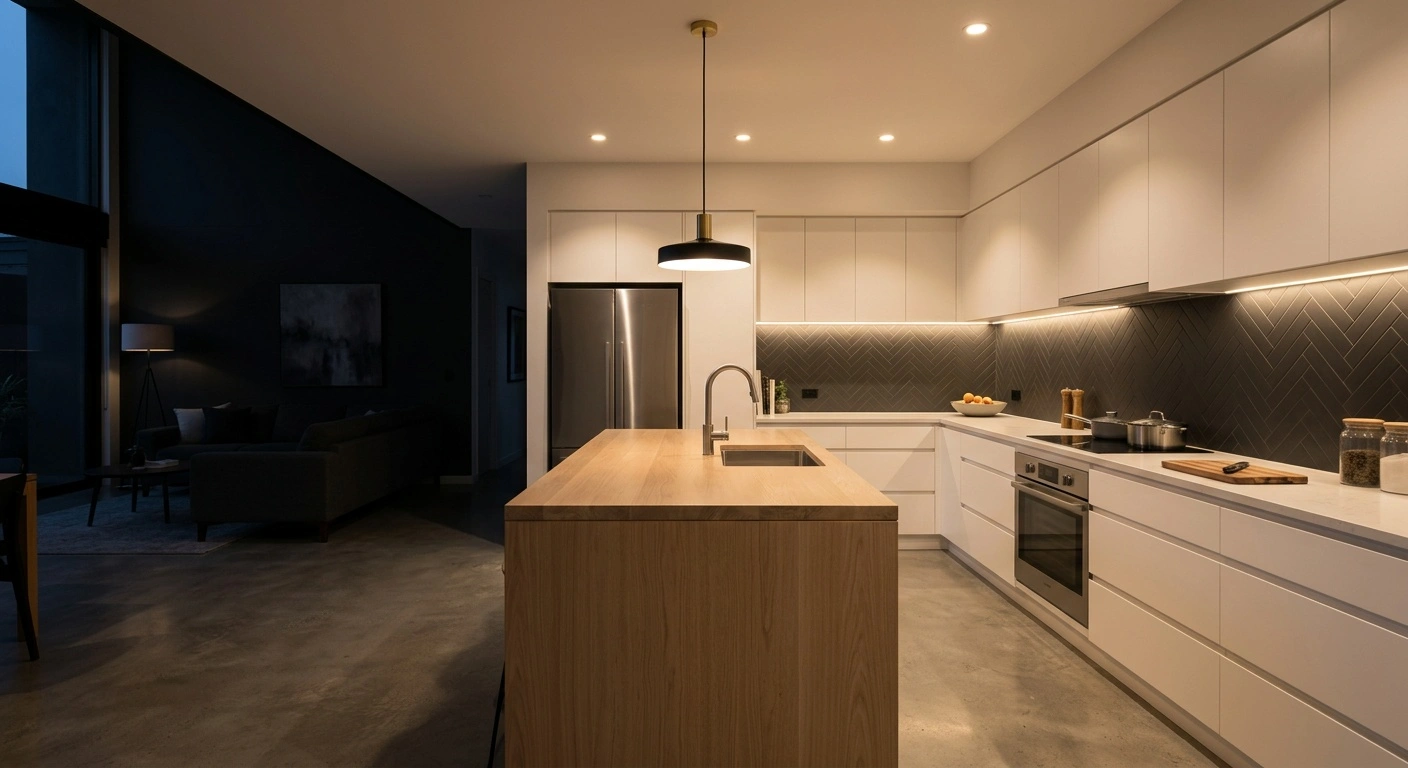
An LED light color chart connects the appearance of white light with correlated color temperature, or CCT, measured in kelvins. It helps you choose a bulb that looks warm, neutral, or cool. For most homes, choose 2700K for an incandescent-like glow or 3000K for a cleaner warm white. Use 3500K to 4000K for task lighting and 5000K only when you want a crisp daylight appearance.
Color temperature does not indicate brightness, color accuracy, or a perfect match between lamps. Lumens measure brightness, while CRI describes general color rendering. Better specification sheets may also list R9 or TM-30 values. Tint consistency, dimming performance, fixture optics, and room colors all affect the final result.
How to Read an LED Light Color Chart
The Kelvin scale for white LEDs works opposite to what many people expect. Lower numbers look warmer, while higher numbers look cooler. A 2200K lamp creates amber-toned light similar to a dimmed incandescent bulb. In comparison, a 5000K lamp appears blue-white.
Write Kelvin with a capital K and no degree symbol. The value technically represents correlated color temperature because an LED does not produce light through heat. Instead, CCT compares the LED’s color appearance with that of a theoretical heated source.
Labels such as soft white, warm white, cool white, and daylight are not precise enough for matching lamps. One brand may call 3000K warm white, while another reserves that description for 2700K. Check the numeric CCT instead.
Printed color samples and on-screen previews are also unreliable. Paper, displays, and surrounding light can change their appearance. Use the ranges below as a starting point, then confirm the lamp or fixture specification.
| Color temperature | Typical appearance | Residential use | Main tradeoff |
|---|---|---|---|
| 1800K–2200K | Deep amber, similar to flame or a heavily dimmed incandescent | Decorative lamps, evening accents, and candle-style effects | Can make whites and cool colors look yellow or muted |
| 2400K–2700K | Very warm to familiar incandescent-like white | Bedrooms, living rooms, dining rooms, and table lamps | May look too yellow on gray, white, or blue finishes |
| 3000K | Warm white with less amber | Kitchens, bathrooms, hallways, and modern living spaces | Feels less relaxed than 2700K in evening spaces |
| 3500K | Balanced warm-neutral white | Laundry rooms, workrooms, and mixed-use kitchens | May look mismatched beside both 2700K and 4000K lamps |
| 4000K | Neutral to slightly cool white | Garages, workshops, utility rooms, and detailed task areas | Often feels stark in bedrooms and traditional interiors |
| 5000K–6500K | Crisp daylight to distinctly blue-white | Specialized task lighting where cool light is intentional | Can increase glare and make a home feel clinical |
Choosing Kelvin by Room and Surface
The right Kelvin value depends on the room’s purpose and the surfaces you need to illuminate. Warm wood, brick, leather, and beige fabrics often look comfortable under 2700K or 3000K. White cabinetry, stainless steel, concrete, and cool gray finishes may look cleaner at 3000K to 4000K.
However, every modern room does not need cool light. A 5000K bulb can make a white kitchen look harsh after dark. Start with the room’s main activity. Then consider its finishes and the amount of daylight it receives.
Avoid mixing noticeably different color temperatures within one sight line unless you want visible contrast. For example, 2700K pendants may look orange beside 4000K recessed lights. Lamps can also differ when both packages show 3000K, especially across product lines or production batches.
For a consistent room, buy lamps from the same manufacturer and product family. Replace failed bulbs with the same model when matching matters. If that model is unavailable, test one replacement before purchasing a full set.
| Room or area | Useful starting CCT | CRI target | Why it works |
|---|---|---|---|
| Living room | 2700K–3000K | 90 or higher preferred | Preserves warm finishes and comfortable evening ambience |
| Bedroom | 2400K–3000K | 80 minimum; 90 preferred | Keeps bedside and general lighting from looking stark |
| Kitchen ambient lighting | 3000K–3500K | 90 or higher | Balances a residential appearance with clear food and surface colors |
| Kitchen counter lighting | 3000K–4000K | 90 or higher with strong red rendering | Provides clean task light without requiring blue-white output |
| Bathroom vanity | 2700K–3500K | 90 or higher | Renders skin tones naturally when the fixture controls glare |
| Laundry or utility room | 3500K–4000K | 80 minimum; 90 preferred for stain sorting | Improves visual separation between light-colored materials |
| Garage or home workshop | 4000K–5000K | 80 minimum; 90 preferred for color-critical work | Supports detailed tasks and gives the space a crisp appearance |
Kelvin Is Not Brightness
A higher color temperature can appear brighter even when the lamp produces no extra light. Compare brightness in lumens, not watts or kelvins. An LED that produces about 800 lumens roughly replaces a traditional 60-watt incandescent bulb. However, beam shape and fixture losses affect how much light reaches the work surface.
Watts describe electrical power use. They do not measure brightness. Two 9-watt LEDs can produce substantially different lumen outputs.
Cool light often looks crisper on white surfaces. As a result, a 5000K lamp may seem brighter than a 2700K lamp with the same lumen rating. That impression does not guarantee better visibility, especially if the cooler source creates glare.
Beam angle also matters. A narrow beam concentrates light in a smaller area, while a wide beam spreads it across more space. Choose lumen output and beam pattern for the task first. Then select a suitable color temperature.
| Specification | What it measures | What it does not measure |
|---|---|---|
| Kelvin or CCT | The warm-to-cool appearance of white light | Brightness or color accuracy |
| Lumens | Total visible light output | Power consumption or beam concentration |
| Watts | Electrical power drawn | Brightness |
| Beam angle | How broadly the fixture distributes light | Total light output |
| CRI | General color rendering compared with a reference source | Exact tint or complete color quality |
CRI, R9, and Tint Matter Too
CRI compares how a light source renders test colors against a reference source with a similar color temperature. An 80 CRI LED is usually adequate for hallways and basic circulation areas. Choose 90 CRI or higher for kitchens, bathrooms, wardrobes, artwork, and rooms with rich finishes.
CRI is not a percentage. Also, two lamps with a 90 CRI rating can render red objects differently. The general CRI value does not fully describe saturated colors.
When the manufacturer provides it, check the R9 value. R9 measures the rendering of a strong red test sample. It can help predict how food, wood, fabric, and skin tones will appear. Higher positive values generally indicate better red rendering.
Detailed specification sheets may also include IES TM-30 fidelity and gamut data. These metrics describe color performance more completely than CRI alone. For most homes, a reputable 90-plus CRI lamp at the right CCT provides a sound baseline. Test a sample first in color-sensitive rooms.
Why LEDs With the Same Kelvin Rating Can Look Different
Two 3000K LEDs can share a nominal CCT while showing different tints. One may look slightly green, while the other appears pink. Kelvin describes a position along a warm-to-cool path, but it does not fully describe tint around that path.
Technical specification sheets may use Duv or chromaticity coordinates to describe this difference. Basic bulb packaging rarely includes these figures. However, they matter when many fixtures need to match across a ceiling.
Manufacturers may describe color consistency with SDCM steps or MacAdam ellipses. A smaller step value generally indicates tighter visible matching. Even closely matched LEDs can shift slightly as they warm up, age, or operate at different drive currents.
Diffusers, painted reflectors, cabinet finishes, and colored walls also affect the light you see. If matching matters, install sample lamps in the actual fixtures. Let them run for several minutes, then compare them at night without daylight in the room.
Dimming, Color Shift, and Flicker
Most standard dimmable LEDs keep roughly the same color temperature as their output drops. Incandescent bulbs behave differently because they become noticeably warmer when dimmed. Choose warm-dim or dim-to-warm LEDs if you want that effect.
A warm-dim lamp might shift from about 3000K at full output to around 2200K at a low setting. Check the stated dimming range before buying. Some lamps stop dimming before they reach a low, candle-like level.
Tunable-white fixtures work differently. Their controls let you choose from a range of color temperatures. Depending on the system, you can adjust CCT independently from brightness or link both settings.
Use an LED-rated dimmer with dimmable LED lamps. An older incandescent dimmer can cause flicker, buzzing, limited range, or poor shutoff behavior. Check the dimmer manufacturer’s compatibility list for the specific lamp or fixture.
Test a small installation before fitting an entire room. LED driver electronics can behave differently under low electrical loads. Wall dimmers involve line-voltage wiring, so hire a licensed electrician unless local rules allow the work and you have suitable training.
White Light Versus RGB and Colored LEDs
An LED light color chart for decorative strips may show red, green, blue, cyan, magenta, and yellow instead of Kelvin values. Those charts describe emitted colors or controller settings, not the CCT of white light. Basic RGB strips create an approximate white by combining red, green, and blue channels. That mixed white often has weak color rendering and a visible tint.
RGBW products add a dedicated white channel. RGB+CCT systems usually add both warm-white and cool-white channels, which provide a wider adjustable range. These extra channels produce more useful white light than RGB mixing alone.
Manufacturers specify saturated, single-color LEDs by wavelength in nanometers. White LEDs cover a broad spectrum, so CCT and color-rendering data describe them more effectively. Controller color wheels are not calibrated instruments. The same on-screen choice can look different across two strip-light systems.
Diffuser depth and diode spacing determine how smoothly the colors blend. Poor spacing can leave visible dots or separate color bands. For countertop or shelf illumination, choose a strip with a dedicated high-CRI white channel.
| LED type | How it produces color | Best residential use | Main limitation |
|---|---|---|---|
| Fixed white | Uses one specified CCT | General and task lighting | You cannot adjust the color temperature |
| Warm-dim | Shifts warmer as light output decreases | Living rooms, dining rooms, and bedrooms | Shift range and dimmer compatibility vary |
| Tunable white | Mixes warm-white and cool-white channels | Multipurpose rooms and adjustable task lighting | Requires a compatible controller and driver |
| RGB | Mixes red, green, and blue channels | Decorative accent lighting | Mixed white is usually unsuitable for accurate task lighting |
| RGBW | Adds one dedicated white channel | Decorative effects plus usable white accent light | The white channel has one fixed CCT |
| RGB+CCT | Combines color channels with warm and cool white | Decorative lighting and adjustable-white installations | Requires more complex controls and wiring |
Fixture, Location, and Heat Compatibility
A high-quality lamp can still fail early in the wrong fixture. Enclosed fixtures trap heat, which can shorten LED life. Check for an enclosed-fixture rating before placing a replacement bulb inside a sealed globe or housing.
Manufacturers may state lamp life with an L70 rating in hours. L70 estimates when average light output will fall to 70 percent under test conditions. It does not guarantee that every lamp or driver will operate for that long. High ambient temperatures can accelerate both lumen loss and driver failure.
For household fixtures, look for a recognized safety certification, such as a UL or ETL listing in the United States. Also check the dry-, damp-, or wet-location rating. A bathroom fixture outside direct spray may need a damp-location rating. Equipment exposed to shower spray or splashing needs an appropriate wet-location listing.
Some products use ingress protection, or IP, ratings. IP44 indicates protection against splashing water, while IP65 indicates protection against water jets. Neither rating permits submersion. Local electrical and building codes take priority over general product guidance.
Hire a licensed electrician for new junction boxes, hardwired fixtures, circuits, and permit-related work. The same advice applies when bathroom zones or local rules create uncertainty. Proper installation protects both the lighting equipment and the people using the space.
Common LED Color Selection Mistakes
A common mistake is buying daylight lamps for every room because the package compares them with natural light. Daylight changes throughout the day. By contrast, a fixed 5000K or 6500K source can look strongly blue-white in a home at night.
Mixing 2700K, 3000K, and 4000K lamps in adjoining fixtures also causes problems. Even a 300K difference may become obvious when two lamps illuminate the same white wall. Test adjacent fixtures together before committing to several products.
Buyers also use watts as a brightness measure instead of checking lumens. Others focus on Kelvin but accept low CRI in rooms where color matters. Lamp size, beam angle, dimmability, fixture rating, and location listing deserve equal attention.
A good LED light color chart narrows the visual choices, but it cannot cover the entire specification. The lamp must fit the fixture, produce enough light, render colors well, and operate safely. Check all these factors before buying a full room’s worth.
How to Make the Final Choice
Start with one color-temperature family for each connected area. Use 2700K to 3000K for relaxation spaces and 3000K to 3500K for most kitchens and bathrooms. Garages and detailed work areas often benefit from 4000K to 5000K.
Next, choose lumens based on the required brightness. Do not use a cooler Kelvin value as a substitute for more light. Select 90-plus CRI where people, food, clothing, wood, or artwork need to look natural.
Check the beam angle for directional lamps and confirm that the lamp fits without blocking ventilation. For dimming, verify compatibility between the LED and the dimmer. Choose a warm-dim product if you want a more amber color at low output.
Before installation, confirm the enclosed-fixture and location ratings. Also look for the appropriate safety certification. Then buy one sample and test it after dark against the paint, flooring, cabinetry, and nearby fixtures.
The right result is not the highest Kelvin number on the LED light color chart. It is a practical combination of CCT, lumens, color rendering, light distribution, and fixture compatibility. Judge the lamp in the room where you plan to use it.