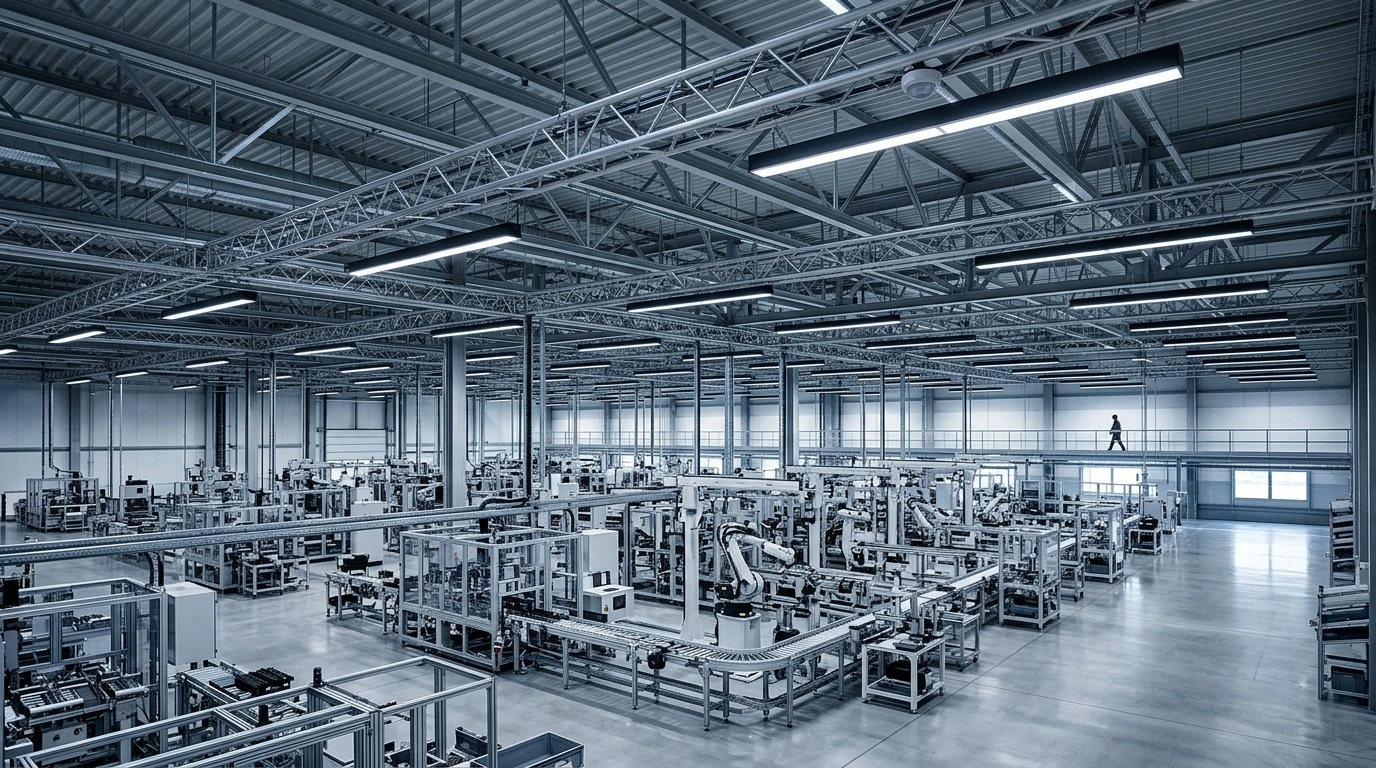
The question “what is new in industrial led lighting” now centers on controls, efficiency, serviceability, and better optical performance. Manufacturers continue to improve light output while reducing wasted energy and glare. Facilities also have more tools for monitoring fixtures and adjusting light levels.
These changes matter in warehouses, factories, cold-storage buildings, and hazardous locations. However, the right upgrade still depends on mounting height, operating conditions, and the work performed below each fixture.
A practical look at what is new in industrial led lighting
Recent industrial LED products offer more than higher lumen output. Many fixtures now support field-adjustable wattage, selectable light output, and interchangeable optics. These features help contractors match one product family to several areas.
Controls have improved as well. Occupancy sensors, daylight sensors, and wireless networks can reduce energy use without leaving work areas underlit. Facility teams can also track operating hours, power consumption, and fault alerts from a central dashboard.
Higher efficacy with better light control
Modern high-bay and low-bay fixtures produce more light per watt than earlier LED models. Yet efficacy alone does not determine performance. A fixture must place useful light on floors, racks, conveyors, and work surfaces.
Manufacturers now offer narrower aisle optics, wide distributions, and asymmetric patterns for specific layouts. Good optical control can reduce fixture counts and limit glare. It may also improve vertical illumination on warehouse racks.
Buyers should compare delivered lumens, distribution data, and input wattage. Laboratory photometric files provide more useful information than a simple “LED equivalent” claim.
Field-adjustable output
Many industrial fixtures now include selectable wattage or lumen settings. Contractors can adjust the output during installation instead of ordering separate models for every ceiling height.
This flexibility also helps facilities manage future layout changes. For example, a team can lower output after moving a demanding task or adding reflective equipment. Staff should document each setting so future maintenance crews can reproduce it.
Smarter sensors and networked controls
Integrated sensors have become smaller and easier to configure. Installers can set time delays, occupancy sensitivity, and dimming levels with a remote, mobile app, or control platform.
Networked systems add scheduling and zone control. Some platforms also report energy use and fixture status. These tools help maintenance teams identify abnormal behavior before a dark fixture disrupts production.
Wireless controls can simplify retrofit projects because they require less control wiring. Still, facilities should review cybersecurity, software support, and replacement-part availability before selecting a proprietary platform.
Improved glare management
High-output fixtures can cause visual discomfort when workers look toward exposed LEDs. Newer designs use diffusers, reflectors, lenses, and larger luminous surfaces to soften brightness.
Glare control deserves extra attention in areas with forklifts, overhead cranes, or detailed inspection work. A fixture with slightly lower efficacy may provide better visibility if it controls high-angle brightness.
Project teams should review Unified Glare Rating data where manufacturers provide it. They should also test sample fixtures in the actual space when glare presents a safety concern.
Lighting designed for demanding environments
Industrial sites often expose fixtures to dust, moisture, chemicals, vibration, and temperature extremes. Manufacturers now offer a wider range of sealed fixtures with application-specific ratings.
Cold-storage and high-temperature products
LEDs perform well in cold conditions, but drivers and seals still need suitable temperature ratings. Freezers also require careful moisture control because condensation can damage poorly protected components.
High-temperature facilities present a different challenge. Foundries, boiler rooms, and process areas need fixtures with drivers and thermal systems designed for sustained heat. Buyers should check the rated ambient temperature rather than relying on a general “industrial” label.
Hazardous-location lighting
Oil, gas, chemical, grain, and manufacturing sites may contain flammable gases or combustible dust. These locations require fixtures certified for the correct class, division, zone, group, and temperature code.
New hazardous-location LEDs offer improved optics, lighter housings, and more control options. Certification still governs product selection. A standard vapor-tight fixture cannot replace a properly listed hazardous-location product.
Washdown and food-processing areas
Food plants and sanitation zones need fixtures that resist water, cleaning chemicals, and repeated temperature changes. Smooth housings and sealed entry points can reduce places where residue collects.
Teams should verify ingress protection ratings and sanitation requirements for each room. They should also confirm that the lens material can tolerate the facility’s cleaning agents.
Serviceability and longer product life
Industrial buyers increasingly look beyond the rated life of the LED chips. Drivers, sensors, connectors, and surge-protection devices can fail before the light source reaches its projected operating life.
Some newer fixtures use replaceable drivers and control modules. Others provide tool-free access to key components. These designs can reduce repair costs and keep the housing in service longer.
Warranty terms need careful review. Buyers should check coverage length, labor provisions, operating-hour limits, and temperature restrictions. A long headline warranty may include conditions that affect an industrial installation.
Surge protection and electrical quality
Industrial electrical systems can expose lighting to switching events and voltage disturbances. Better fixtures often include stronger surge protection or allow installers to add external protective devices.
Facilities should match protection levels to local electrical conditions. Sites with large motors, outdoor feeds, or frequent lightning may need additional safeguards. An electrical engineer can assess unusual power-quality problems.
Human-centered performance without marketing claims
Manufacturers now offer more choices for color temperature, color rendering, and spectral output. These options can improve visual inspection, material sorting, and employee comfort when the application supports them.
Higher color rendering may help workers distinguish wires, labels, finishes, or product defects. However, it can reduce efficacy or increase cost. The project team should connect each specification to a real task.
Tunable-white lighting has entered some industrial and support spaces. It makes more sense in training rooms, laboratories, or facilities with changing visual needs than in a basic storage aisle.
How to evaluate an industrial LED upgrade
A useful answer to “what is new in industrial led lighting” must connect new features to measurable site needs. Start with a lighting audit that records fixture types, mounting heights, operating hours, and existing light levels.
Next, identify areas with glare, shadows, poor vertical illumination, or frequent maintenance calls. Use a photometric layout to compare proposed fixtures. The calculation should include light loss, surface reflectance, and obstructions.
Review applicable safety rules, energy codes, and rebate requirements before ordering equipment. Programs and product qualifications vary by region. Confirm current requirements with the relevant authority or utility.
Questions to ask suppliers
- Can the supplier provide complete photometric files and test reports?
- What ambient temperature range does the fixture support?
- Can technicians replace the driver, sensor, or surge protector?
- Which control protocols does the fixture support?
- Does the product carry the required wet-location or hazardous-location certification?
- How does the warranty cover labor, controls, and replacement parts?
- Will the manufacturer support the control platform throughout the expected fixture life?
Choosing useful advances over unnecessary features
The clearest answer to “what is new in industrial led lighting” involves adaptable fixtures, stronger controls, better optics, and more serviceable components. These advances can lower operating costs and improve visibility when teams apply them correctly.
A successful project begins with the work area rather than a product brochure. Measure the space, define the visual task, and confirm environmental ratings. Then select the features that solve documented problems.