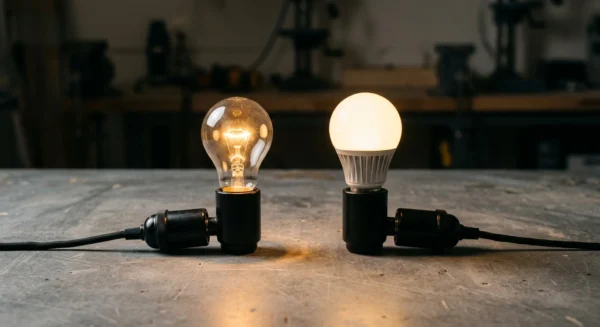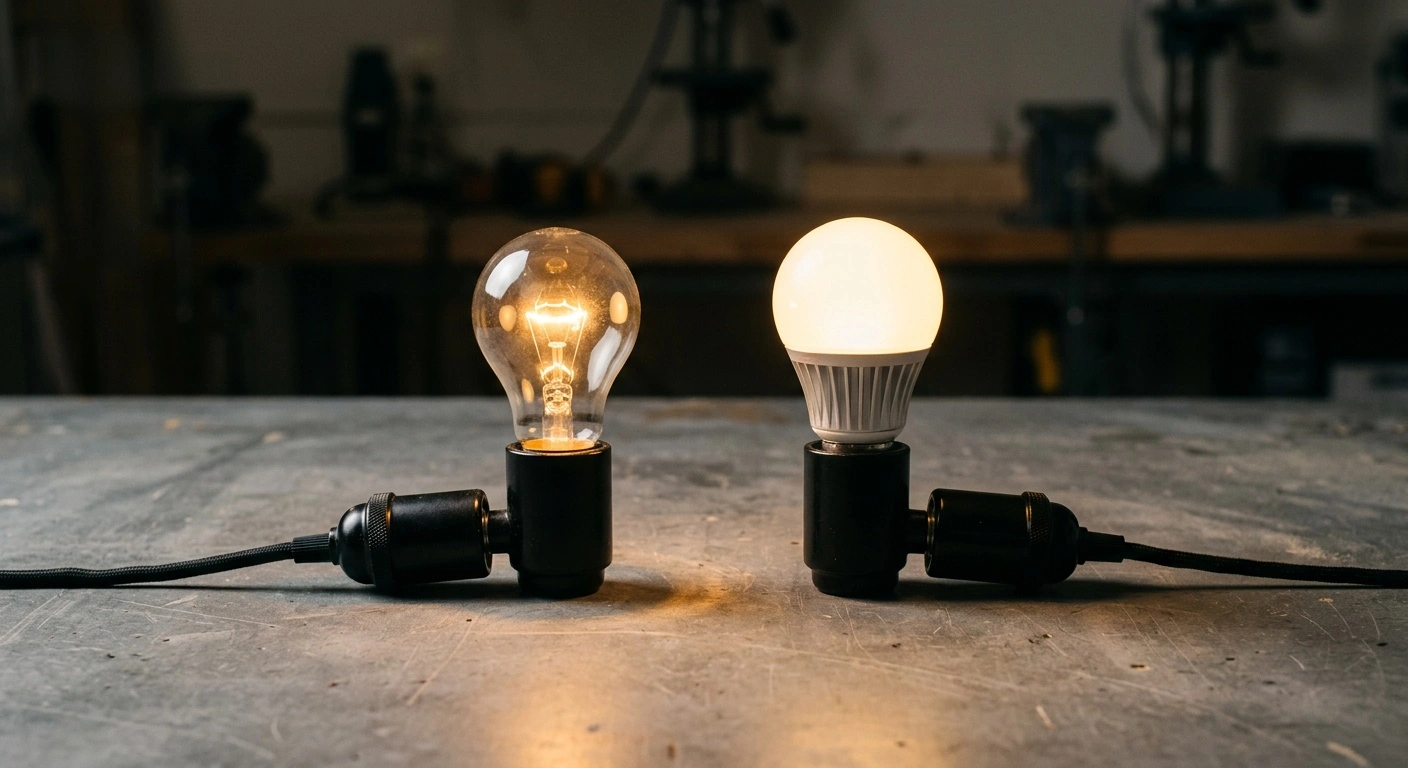
An incandescent light bulb vs LED comparison has a clear winner for most homes: the LED. LED bulbs use far less electricity, last much longer, and produce the same brightness with less heat. A typical 800-lumen LED draws 8 to 10 watts. An incandescent bulb with similar output draws about 60 watts.
This difference matters more than the watt-equivalent language printed on packaging. Lumens measure light output, while watts measure electricity use. Incandescent bulbs still offer smooth dimming, warm color, and a low purchase price. However, their operating cost remains much higher.
Incandescent Light Bulb vs LED at a Glance
An incandescent bulb heats a tungsten filament until it glows. This simple process converts most of the electrical input into heat rather than visible light. An LED passes current through semiconductor diodes and directs the resulting light through a diffuser or lens.
Common incandescent bulbs produce about 10 to 15 lumens per watt. Modern residential LEDs often produce 80 to 100 lumens per watt. Both types reach full brightness immediately, unlike older compact fluorescent lamps.
Incandescent bulbs render colors accurately and dim smoothly on conventional controls. LEDs can provide comparable color quality, but shoppers should check the color rendering index. Choose a CRI of at least 90 for skin tones, food, artwork, and wood finishes.
| Characteristic | Incandescent bulb | LED bulb |
|---|---|---|
| Typical household light output | About 800 lumens | About 800 lumens |
| Typical power draw at that output | About 60 watts | About 8 to 10 watts |
| Typical efficacy | About 10 to 15 lumens per watt | About 80 to 100 lumens per watt |
| Rated life | Often about 1,000 hours | Commonly 10,000 to 25,000 hours, depending on the product and test conditions |
| Warm-up time | Instant | Instant |
| Dimming | Smooth on conventional incandescent dimmers | Good with a dimmable bulb and compatible LED-rated dimmer |
| Color quality | CRI close to 100 | Usually 80 or 90-plus CRI |
| Initial cost | Generally lower | Generally higher |
| Operating cost | Higher because of greater power draw | Lower because of greater efficacy |
Compare Brightness in Lumens, Not Watts
Compare bulb brightness in lumens, not watts. A 60-watt incandescent and a 9-watt LED can both produce about 800 lumens. Their electricity use differs substantially even though their light output matches.
Watt-equivalent labels on LED boxes provide replacement shorthand. They do not measure actual brightness. A package marked “60-watt replacement” should still list about 800 lumens.
The right lumen level depends on the room, fixture, surface colors, and intended use. Dark walls and lampshades absorb light, so the same bulb may look weaker in one room. Clear bulbs can also appear more glaring than frosted bulbs with equal output.
Always check the fixture’s maximum wattage label. Use the LED’s actual wattage for this comparison, not its replacement rating. A 9-watt LED marked as a 60-watt replacement draws only 9 watts.
Common Residential Brightness Levels
About 450 lumens usually replaces a traditional 40-watt incandescent bulb. Around 800 lumens matches the familiar 60-watt range. Approximately 1,100 lumens replaces many 75-watt bulbs, while 1,600 lumens often replaces a 100-watt bulb.
These figures describe broad output classes, not how bright every room will look. Shades, diffusers, and recessed housings can reduce the light that reaches a work surface. Therefore, test one LED before replacing every bulb in a room.
Directional BR and PAR lamps distribute light differently from omnidirectional A19 bulbs. For recessed cans and track lighting, check the beam angle as well as total lumens. Center-beam intensity can also affect task lighting performance.
| Desired light output | Typical incandescent draw | Typical LED draw | Common residential use |
|---|---|---|---|
| About 450 lumens | About 40 watts | About 4 to 6 watts | Accent lamp or low-level bedside light |
| About 800 lumens | About 60 watts | About 8 to 10 watts | Table lamp or general room lighting |
| About 1,100 lumens | About 75 watts | About 10 to 13 watts | Brighter floor lamp or work area |
| About 1,600 lumens | About 100 watts | About 14 to 17 watts | Large room or high-output open fixture |
Color Temperature and Color Rendering
Incandescent light has a naturally warm appearance near 2700K. A 2700K LED provides the closest general replacement for living rooms and bedrooms. A 3000K bulb looks cleaner and slightly less yellow, which often suits kitchens and bathrooms.
At 4000K, light appears neutral white. It may look stark beside warm wood, beige walls, or traditional furnishings. Color temperature describes the appearance of the light, not its brightness.
A 2700K bulb and a 4000K bulb can each produce 800 lumens. CRI indicates how faithfully a light source reveals colors compared with a reference source. Incandescent bulbs score close to 100, while standard LEDs often have an 80 CRI rating.
Better residential LEDs offer a CRI of 90 or higher. Choose 90-plus CRI for bathroom mirrors, closets, kitchens, artwork, and other color-sensitive areas.
Electricity Cost and LED Payback
Lower electricity use gives LEDs their strongest advantage in an incandescent light bulb vs LED decision. The savings come from lower wattage at the same lumen output. They do not require reduced brightness.
To estimate operating cost, convert watts to kilowatts and multiply by annual operating hours. Then multiply the result by your electricity rate. Since 1,000 watts equal one kilowatt, a 60-watt bulb draws 0.060 kilowatts.
Daily use affects savings as much as wattage. A hallway bulb running ten minutes per day will save little. A kitchen lamp used for several hours each evening offers a much faster payback.
Electricity prices also vary by location and utility plan. Use the rate shown on your utility bill for a useful estimate. Savings claims need three figures: wattage, operating hours, and the electricity rate.
Annual Electricity Cost Example
Consider an 800-lumen incandescent drawing 60 watts and an 800-lumen LED drawing 9 watts. If each runs three hours daily, annual use totals 1,095 hours. At $0.17 per kilowatt-hour, the incandescent consumes 65.7 kilowatt-hours per year.
That incandescent costs about $11.17 annually to operate. The LED consumes 9.855 kilowatt-hours and costs about $1.68. The annual difference equals roughly 55.85 kilowatt-hours and $9.49 per bulb.
This change cuts electricity use by 85 percent because power demand falls from 60 watts to 9 watts. The calculation does not include either bulb’s purchase price.
Replacement Cost and Rated Life
An incandescent filament usually fails suddenly. An LED often grows dimmer over time, although heat can also damage its electronic driver. Manufacturers commonly rate LEDs for 10,000 to 25,000 hours.
Some manufacturers use L70 to describe LED life. L70 marks the point when output falls to 70 percent of its initial level. A rated-life figure reflects testing under specified conditions, not a guarantee for every bulb.
Heat, voltage changes, frequent switching, and driver quality all affect service life. Cheap LEDs in hot, sealed globes may fail much sooner than their packaging suggests. Compare rated hours, warranty coverage, fixture approval, and manufacturer support.
Long life matters most in stairwells, high ceilings, and other hard-to-reach locations. It provides less value in a closet that sees only a few minutes of daily use.
Efficiency and Heat in Real Fixtures
LED bulbs produce less heat than incandescent bulbs, but they are not heat-free. Incandescent bulbs radiate substantial heat through their glass. This heat can warm the shade, socket, and surrounding air.
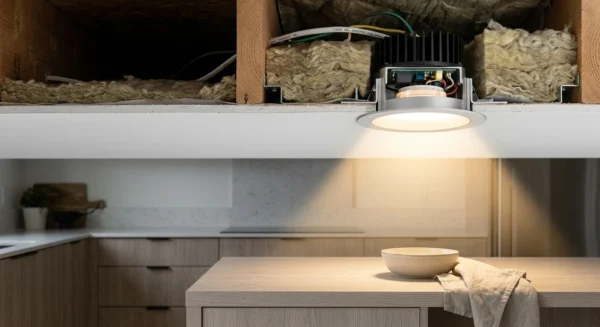
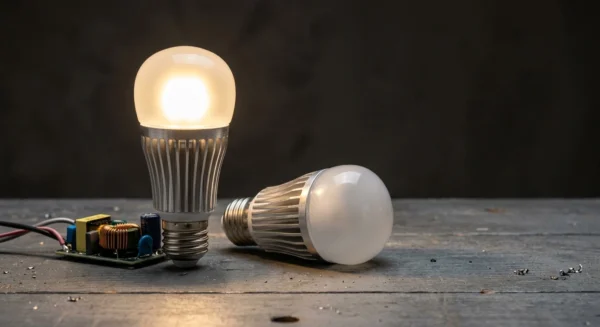
An LED creates less total heat at the same light output. However, its diodes and electronic driver still need a path for heat to escape. Manufacturers build that thermal path into the bulb’s base and housing.
Trapped heat raises component temperatures and shortens LED life. Fully enclosed ceiling globes, sealed porch lights, and compact flush-mount fixtures can create this problem. Use an LED in a sealed housing only when the manufacturer approves it for enclosed fixtures.
A matching base does not prove compatibility. If the package omits enclosed-fixture approval, choose a different bulb. This rule applies even when the LED stays below the fixture’s wattage limit.
Dimming and Fixture Compatibility
Incandescent lamps dim smoothly because the control reduces power to the filament. Their light also becomes warmer as output falls. Many people prefer this effect in dining rooms, bedrooms, and living spaces.
LED drivers regulate current electronically, so standard LEDs may behave differently. Some maintain the same color temperature as they dim. Warm-dim LEDs intentionally shift toward a warmer appearance at lower settings.
Not every LED supports dimming. A non-dimmable LED on a dimmer may flash, buzz, perform poorly, or fail early. Even dimmable bulbs can have problems with an incompatible control.
Check the compatibility guidance from both the bulb and dimmer manufacturers. Several low-wattage LEDs may also fall below a dimmer’s minimum load. In that case, the lights may flicker or refuse to dim fully.
Use a Compatible LED-Rated Dimmer
An LED-rated dimmer usually provides the most reliable control. Old incandescent dimmers commonly cause flicker, buzz, and limited dimming range during LED retrofits. Replacing bulbs repeatedly will not fix an incompatible control.
Choose dimmable bulbs and confirm that the dimmer supports the connected load. If several bulbs share one dimmer, use matching models from the same product line. This reduces differences in startup behavior and low-end brightness.
Some dimmers include a low-end trim adjustment. Set it so the lamps remain stable at the minimum level. Persistent flashing at full brightness may point to a loose connection, bad driver, or voltage problem.
Wall boxes contain line voltage. A licensed electrician should investigate wiring, controls, or connections inside the box.
Location Ratings, Safety Listings, and Bulb Shape
Choose a replacement bulb with a recognized safety listing, such as UL or ETL. The bulb and fixture must also suit the installation location. Dry-location bulbs work in ordinary indoor rooms without moisture exposure.
Damp-location products suit humid or sheltered areas where water cannot strike the bulb directly. Showers and outdoor areas exposed to rain require wet-location-rated equipment. The fixture must also carry the correct rating.
Follow the fixture manufacturer’s ingress protection requirement where applicable. IP65 commonly indicates protection against dust, rain, and water jets. It does not allow submersion.
Check the bulb’s base, voltage, dimensions, and shape before buying. Some LED bulbs interfere with harp fittings, glass covers, or recessed trim despite having the correct base.
Replacing a bulb is usually straightforward. Installing fixtures, opening junction boxes, adding circuits, or changing line-voltage wiring requires a licensed electrician.
Where Incandescent Bulbs Still Make Sense
Incandescent bulbs retain a few practical advantages despite their poor efficiency. They dim predictably, provide a CRI close to 100, and create familiar warm light. Their low purchase price may also suit a rarely used decorative lamp.
Some specialty fixtures need a precise filament position or a particular bulb shape. Certain high-temperature appliances also require purpose-built appliance lamps. Never substitute an ordinary household bulb where the appliance manufacturer specifies a dedicated lamp.
Incandescent bulbs still consume far more electricity at the same light output. They also add more heat to the room. Current efficiency standards and local rules may limit their availability.
For lighting used several hours daily, smooth dimming rarely offsets the higher energy and replacement costs. Incandescent bulbs make their strongest case in low-use, decorative, or specialty applications.
How to Choose the Right Replacement Bulb
Start by matching the old bulb’s light output in lumens rather than copying its wattage. Choose 2700K for traditional warm light or 3000K for a cleaner white. Select 4000K where you want neutral, task-oriented lighting.
Choose a CRI of at least 90 when color accuracy matters. If the fixture uses a dimmer, buy a dimmable bulb and confirm control compatibility. For enclosed fixtures, look for explicit enclosed-fixture approval.
Next, verify the UL or ETL listing and the dry, damp, or wet location rating. Check the bulb’s dimensions as well as its base. LED housings can be wider or longer than incandescent glass envelopes.
An 800-lumen LED drawing 8 to 10 watts can replace a typical 60-watt incandescent. The incandescent light bulb vs LED choice becomes close only in low-use decorative or specialty settings. For everyday household lighting, LEDs cut energy use and reduce bulb changes without sacrificing brightness.