Are LED lights bad for your eyes? Under normal household use, current expert guidance does not show that LEDs damage healthy eyes. However, a poorly chosen lamp can cause glare, visible flicker, headaches, or visual strain. Discomfort is real, but it does not necessarily indicate retinal injury.
Brightness at the eye, exposure time, optical design, flicker, and viewing distance matter more than the light source technology. A bare, high-output LED array creates a different exposure than LEDs behind a shade or diffuser. This article covers ordinary indoor residential lighting. It does not cover lasers, ultraviolet lamps, medical devices, stage lighting, or high-intensity industrial equipment.
Are LED Lights Bad for Your Eyes During Normal Household Use?
Properly designed LED bulbs and fixtures do not inherently harm healthy eyes during normal household use. Optical safety organizations assess the light that reaches the eye rather than judging the source technology alone. LEDs, fluorescent tubes, and incandescent filaments can all cause discomfort or injury if they produce enough intensity.
The International Commission on Non-Ionizing Radiation Protection publishes guidance for optical radiation exposure. The International Commission on Illumination explains how experts should evaluate blue-light hazard using spectral radiance and exposure duration. Manufacturers and laboratories also use the IEC 62471 framework to assess photobiological risks, including retinal and ultraviolet exposure.
These frameworks do not support the claim that every blue-white LED damages the retina. However, they do not make every product suitable for prolonged, close-range viewing. High-output lamps with small, exposed emitters require particular care.
Keep bright sources outside your direct line of sight. Use a shade, baffle, or diffuser, and provide enough light without creating a glaring hot spot. If a fixture makes you squint or leaves an afterimage, change its position, output, or optical design.
What Major Expert Reviews Say About LED Eye Safety
The European Commission’s Scientific Committee on Health, Environmental and Emerging Risks reviewed the potential health effects of LEDs. It found no evidence that normal use directly harms the general healthy population. The review also noted that some people may react more strongly to flicker or particular lighting conditions.
France’s Agency for Food, Environmental and Occupational Health and Safety takes a more precautionary position. Its concerns focus on intense blue-rich sources, children, nighttime exposure, and products with poor flicker control. Those concerns do not show that a shaded 2700K table lamp damages the eye.
The CIE stresses that correlated color temperature alone cannot establish blue-light hazard. A 5000K lamp usually contains more blue light than a comparable 2700K lamp. Actual exposure still depends on spectral output, source size, radiance, distance, and viewing time.
Expert reviews also separate retinal photochemical hazard from circadian effects and ordinary glare. These mechanisms require different measurements and should not be treated as one issue. Compliant, sensibly installed household LEDs are generally appropriate. Intense, exposed, flickering, or poorly aimed products need correction.
Blue Light: What to Check Instead of Fearing the Color
Blue light forms part of the visible spectrum. Daylight, screens, fluorescent lamps, and many LEDs all produce it. Most white LEDs combine a blue-emitting diode with phosphors that convert some output into longer wavelengths.
Cooler color temperatures, such as 5000K, usually look blue-white. Warmer 2700K and 3000K lamps contain proportionally less short-wavelength visible light. However, 5000K is not automatically unsafe. A warm 2700K lamp can still cause discomfort if you stare into it at close range.
For bedrooms and evening living spaces, 2700K to 3000K often feels more comfortable. It creates a warmer appearance and reduces blue-rich light compared with a cool-white lamp of similar output. Kitchens, workshops, and daytime task areas often work well at 3000K to 4000K.
Very cool 5000K lamps can help with color discrimination or detailed daytime tasks. However, many people find them stark at night. Do not treat any color temperature as medical therapy. Research on light timing and sleep does not justify claims that a particular bulb treats insomnia.
| Specification or condition | What it tells you | Practical residential guidance |
|---|---|---|
| 2700K | Warm, amber-white appearance | Suitable for bedrooms, living rooms, and evening use |
| 3000K | Warm white with a slightly crisper appearance | Useful for kitchens, bathrooms, and general household lighting |
| 3500K to 4000K | Neutral white appearance | Suitable for daytime task areas when the fixture controls glare |
| 5000K | Cool, blue-white appearance | Best for specific daytime tasks rather than relaxed evening rooms |
| Photobiological risk group | Optical exposure assessment under defined test conditions | For intense specialty fixtures, choose products with documented IEC 62471 testing |
| CRI | How accurately colors appear against a reference source | CRI 80 is common; choose CRI 90 or higher when color accuracy matters |
Glare Is Usually the Bigger Everyday Problem
Many complaints attributed to LEDs actually come from glare. LEDs can concentrate substantial output within a small area. As a result, an exposed bulb or clear-lens fixture may look painfully bright while leaving the room poorly illuminated.
A 1600-lumen bulb roughly matches the output class of a traditional 100-watt incandescent. That output can feel harsh in a shallow, open fixture at eye level. A frosted globe, deep baffle, or fabric shade spreads the light across a larger visible area.
Do not brighten a dark work surface by installing the brightest exposed bulb available. Instead, add a shielded task light that directs illumination onto the work. Position it so the beam does not shine into your eyes or reflect from a screen.
Residential circulation and ambient areas often use about 100 to 300 lux. Reading areas and kitchen work surfaces commonly benefit from roughly 300 to 500 lux. These ranges are design targets, not medical safety limits. Older occupants and detailed tasks may need more light with stronger glare control.
LED Flicker Can Cause Discomfort
LEDs respond quickly to changes in electrical current. A poor driver or incompatible dimmer can therefore create repeated changes in light output. Slow or deep modulation may look like obvious pulsing, while faster flicker may create visual artifacts during movement.
A phone camera may show flicker as dark bands or rolling lines. This test can reveal an obvious problem, but it cannot provide a calibrated measurement. Camera frame rates and shutter settings can create, exaggerate, or hide bands.
Technical specifications may list short-term flicker severity as PstLM. They may also provide the stroboscopic visibility measure, or SVM. Lower values generally indicate better control, although dimming and other operating conditions can change performance.
IEEE and CIE publications explain how frequency, modulation depth, and exposure affect temporal light modulation. Individual sensitivity also varies. A lamp may cause discomfort for one person while another person notices nothing. That difference does not prove eye damage.
Check the Bulb and Dimmer Compatibility
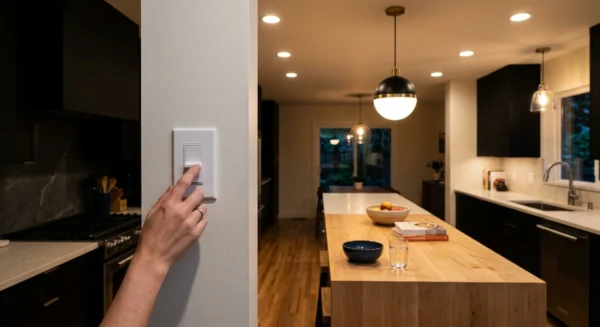
Use a bulb marked as dimmable with a compatible LED dimmer. Older incandescent dimmers often cause LED lamps to flicker, buzz, flash, or shut off. The lamp’s electronic driver may not remain stable at the dimmer’s lowest current.
Check the dimmer manufacturer’s compatibility list and permitted load range. Some combinations also need low-end trim adjustment. This setting prevents shimmer or dropout near the bottom of the dimming range.
If flicker appears only at low settings, raise the dimmer and compare the result with full output. A stable lamp at full brightness points toward dimmer or minimum-load behavior. It does not necessarily indicate a defective LED.
Use a licensed electrician for wall-dimmer replacement unless local rules permit the work and you have the required skills. Persistent flicker at full output across several known-good lamps may signal a loose connection or supply problem. An electrician should investigate that condition.
Brightness, Placement, and Reflections Matter More Than Wattage
Choose lamp brightness in lumens. Watts measure energy use rather than light output. About 800 lumens matches the familiar replacement class for a 60-watt incandescent. Roughly 1100 and 1600 lumens correspond to brighter traditional household lamp classes.
These comparisons do not guarantee equal visual comfort. Beam shape, fixture design, and optical losses determine where the light lands. A narrow beam can produce an intense spot while leaving nearby surfaces dark. A diffuser spreads the same total output more broadly.
Place a reading light beside or slightly behind the reader. The light should illuminate the page without exposing the bare source. At a desk, angle the fixture to prevent reflections from monitors and glossy surfaces.
Increase ambient lighting if a screen looks like a bright rectangle in a dark room. For recessed downlights, choose deep-regress trims, baffles, or controlled beams where people can see the apertures. Aim for useful illumination, moderate contrast, and smooth transitions between surfaces.
How to Choose a Comfortable Household LED
Start with output, distribution, and flicker performance. Marketing labels such as “eye-care light” or “daylight quality” provide little useful evidence by themselves. Look for measurable specifications and a design that hides concentrated LED points.
Choose a frosted bulb, shaded fixture, or integrated diffuser for general room lighting. For relaxed evening rooms, start with 2700K to 3000K. Consider 3000K to 4000K for daytime work areas, depending on the room finishes and your comfort.
CRI 90 or higher can improve the appearance of skin tones, food, wood, and fabrics. However, CRI does not measure flicker, glare, or photobiological safety. Evaluate those characteristics separately.
Choose a UL Listed or ETL Listed product with the correct dry-, damp-, or wet-location rating. In splash-prone bathroom locations, IP44 is a common minimum. Areas exposed to direct water spray may require IP65 and an appropriate wet-location listing. Local electrical codes determine the final requirements.
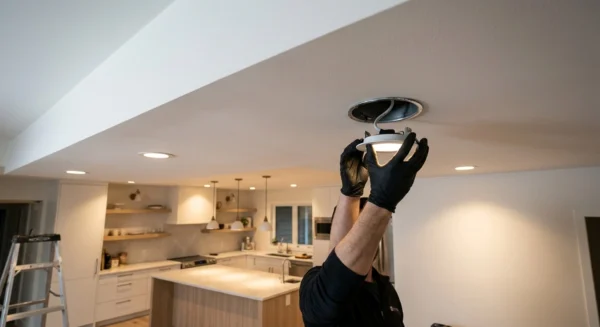
Check the packaging before placing a bulb inside a sealed globe. The manufacturer must specifically rate the bulb for enclosed fixtures because trapped heat shortens driver and LED life. Hire a licensed electrician for hardwired fixtures, junction-box work, new circuits, or permitted installations.
- Look for: suitable lumens, a shielded or diffused source, an appropriate Kelvin value, published dimmer compatibility, and recognized electrical certification.
- Avoid: exposed high-output emitters at eye level, unlisted lamps, vague blue-light protection claims, and products without useful specifications.
- Test at home: check the lamp at full output and several dimmer settings. Inspect it from normal seated and standing positions.
- Return or replace: lamps that visibly pulse, buzz, create persistent afterimages, or cause repeatable discomfort during ordinary use.
Children, Older Adults, and Light-Sensitive Users
Experts often recommend extra care with lighting around children. Children’s eyes transmit light differently, and young children may stare at a source that attracts their attention. Keep intense, exposed emitters out of reach and outside direct sight lines.
Avoid decorative fixtures that show bare LED points near beds, changing tables, play areas, or desks. Use shades, diffusers, and indirect lighting instead. Do not give children high-output flashlights or specialty LED devices as toys.
Older adults often need more task illumination because less light reaches the retina as the eye ages. Contrast sensitivity may also decline. Simply increasing the brightness of an exposed source can make glare worse.
A larger illuminated surface and better task-light placement often provide more usable light. Lighter room finishes may also reduce harsh contrast. These changes can improve visibility without placing a small, intense source in the field of view.
People with migraine, neurological conditions, eye disease, or medication-related light sensitivity may react strongly to brightness or flicker. Responses vary and do not show that LEDs cause or treat those conditions. Discuss persistent lighting problems with an optometrist or ophthalmologist.
When Eye Symptoms Need Professional Assessment
Temporary discomfort under one fixture gives you a clear reason to change the lighting. Remove direct glare, increase ambient light around screens, and test a known low-flicker lamp. Take regular visual breaks during close work.
If symptoms continue across different environments, lighting may not be the only factor. Vision correction, dry eye, migraine sensitivity, and other conditions can cause similar symptoms. A lighting specification cannot diagnose them.
Consult an eye-care professional about persistent eye pain, recurring headaches during visual tasks, unusual light sensitivity, or vision changes. Sudden vision loss requires prompt assessment. The same applies to a curtain-like shadow, an eye injury, or new flashes accompanied by many floaters.
Do not assume household LEDs caused these symptoms. Serious eye problems should not be dismissed as blue-light exposure. Also, never stare into high-output flashlights, exposed grow-light arrays, ultraviolet lamps, or dismantled fixtures. Those specialty sources require separate safety assessments.
The Practical Verdict on LED Lighting and Eye Health
So, are LED lights bad for your eyes? For ordinary residential use, evidence does not show that properly designed LEDs harm healthy eyes. Excessive brightness, exposed emitters, reflections, strong contrast, and flicker cause most everyday complaints.
Choose enough lumens for the task, but keep intense sources outside direct sight lines. Use shades, baffles, or diffusers and select a color temperature that fits the room and time of day. Warm 2700K to 3000K light makes a sensible evening default, while neutral light can support daytime tasks.
Product quality still matters. Two bulbs with identical lumen and Kelvin ratings may use very different drivers and optics. Choose listed products with useful specifications, compatible dimmers, and the correct location and enclosure ratings.
Replace any lamp that causes repeatable glare, pulsing, or discomfort. A well-designed LED can provide comfortable, efficient household lighting. However, no household bulb can diagnose, prevent, or treat an eye or sleep condition.