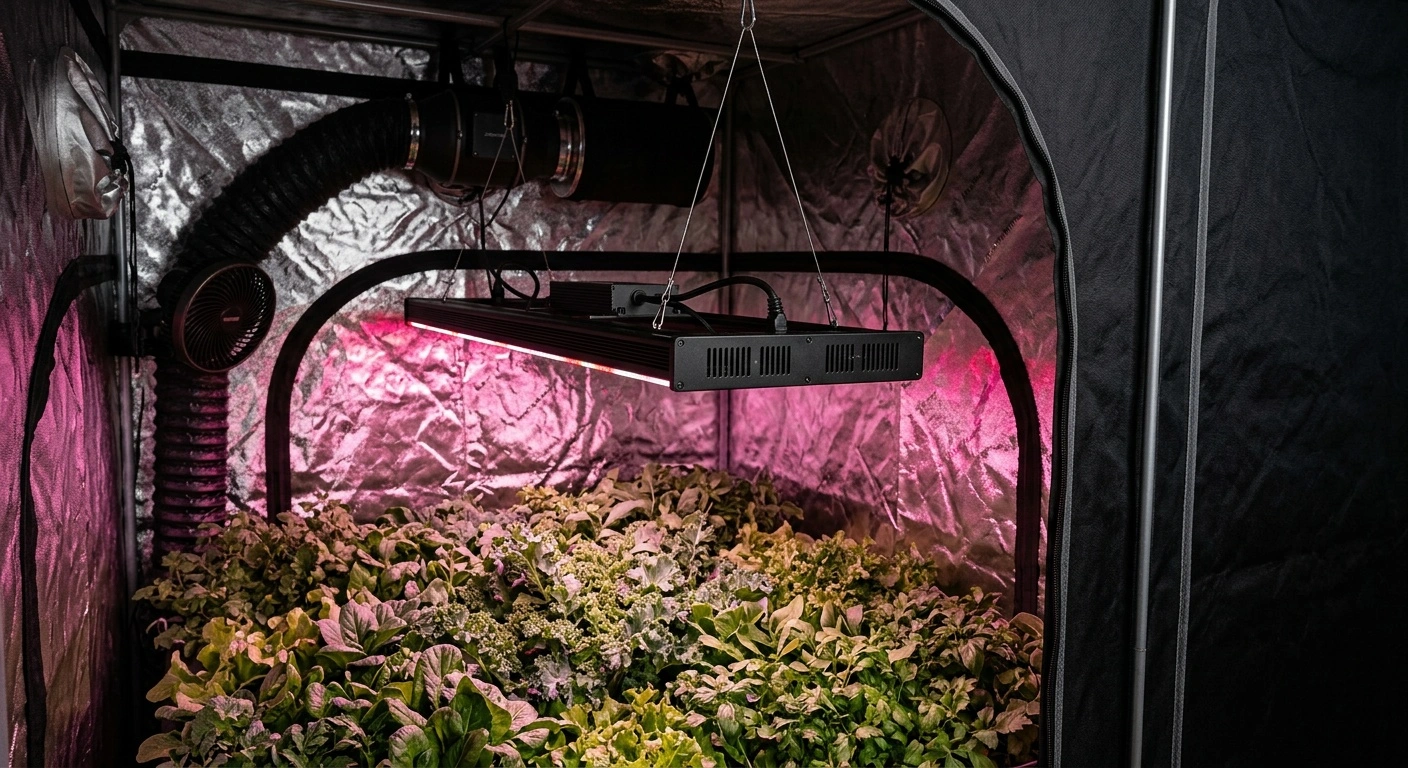
The most efficient led grow lights deliver more usable photons per watt. That lowers electricity use and reduces the heat your cooling system must remove. However, efficiency alone does not guarantee an even canopy or a productive harvest.
Start with fixture-level efficacy, measured in micromoles per joule (µmol/J). Then compare light distribution, spectrum, controls, warranty terms, and verified power draw.
How to compare the most efficient led grow lights
Photosynthetic photon efficacy, or PPE, measures how efficiently a fixture converts electricity into light. Manufacturers calculate PPE by dividing photosynthetic photon flux (PPF) by input wattage.
For example, a 700-watt fixture producing 2,030 µmol/s has an efficacy of 2.9 µmol/J. Premium full-spectrum fixtures generally fall between 2.7 and 3.1 µmol/J at the wall.
Check fixture efficacy, not diode efficacy
LED manufacturers may rate individual diodes above 3.5 µmol/J under controlled test conditions. A complete fixture loses some efficiency through drivers, optics, wiring, and operating temperature.
Look for a PPE figure that covers the complete fixture. The specification should also state actual wall draw and total PPF.
Use independent test data
Manufacturer specifications provide a starting point, but third-party integrating-sphere reports add confidence. Reputable tests record power consumption, PPF, spectrum, and fixture efficacy.
Confirm that each comparison uses the same measurement range. Traditional PPF covers 400 to 700 nanometers, while ePAR extends the range to 750 nanometers.
Efficiency benchmarks for LED grow lights
| Fixture efficacy | General assessment | Typical application |
|---|---|---|
| Below 2.3 µmol/J | Low by current LED standards | Small gardens or older fixtures |
| 2.3 to 2.6 µmol/J | Serviceable efficiency | Budget and midrange systems |
| 2.7 to 2.9 µmol/J | High efficiency | Serious home and commercial growing |
| 3.0 µmol/J or higher | Top-tier fixture performance | Operations focused on energy savings |
These ranges apply to complete fixtures, not bare diodes. Test methods, spectrum choices, and ambient temperature can shift the reported result.
Fixture designs that use power efficiently
Bar-style fixtures
Multi-bar fixtures spread diodes across a broad frame. This design creates even PPFD across square tents, benches, and vertical racks.
Wide spacing also helps the diodes shed heat. As a result, growers can often hang these fixtures closer to the canopy without creating a strong central hotspot.
Board-style fixtures
Board-style lights place many diodes on one or more flat panels. They offer high efficacy, simple installation, and strong output from a compact frame.
However, smaller boards may concentrate light near the center. Review a PPFD map before choosing one for a large growing area.
Linear fixtures for racks
Low-profile linear fixtures suit propagation shelves and vertical farms. Their slim frames leave more room between each light and the crop.
Choose models with dimming controls and detachable drivers when rack temperatures matter. Moving the driver outside the growing area reduces heat near the plants.
Why PPFD distribution matters
A highly efficient fixture can still waste light beyond the canopy. It can also produce weak corners or excessive intensity directly below the center.
Review PPFD maps taken at realistic hanging heights. The test area should match your tent, bench, or room dimensions.
Uniform coverage lets more leaves work within a useful intensity range. It also reduces the need to overdrive the fixture just to reach the edges.
Spectrum and efficiency trade-offs
Red diodes often generate photons more efficiently than white diodes. Still, a heavily red spectrum can make plant inspection and pest detection harder.
Full-spectrum fixtures combine white and red diodes to balance visibility, crop response, and electrical performance. Some models also include ultraviolet or far-red channels.
Compare fixtures with similar spectra whenever possible. A broader spectrum may show slightly lower PPE while offering controls that fit a specific production plan.
How to size an efficient grow light
Match total PPF to the crop, canopy size, and target PPFD. Buying excess output and running it at full power wastes electricity.
For a rough estimate, multiply the growing area in square meters by the target PPFD. Then divide by the expected fraction of light that reaches the canopy.
- Seedlings and clones: roughly 100 to 300 µmol/m²/s
- Leafy greens and herbs: roughly 200 to 500 µmol/m²/s
- High-light flowering crops: roughly 600 to 1,000 µmol/m²/s
Crop requirements vary by cultivar, temperature, carbon dioxide level, and photoperiod. Use a quantum sensor to confirm intensity at canopy height.
Operating cost matters more than purchase price
The most efficient led grow lights often cost more upfront. Calculate energy use before deciding whether the premium makes financial sense.
Multiply fixture wattage by daily operating hours and electricity price. Divide wattage by 1,000 to convert it into kilowatts.
For example, a 700-watt light running 12 hours uses 8.4 kilowatt-hours daily. At $0.15 per kilowatt-hour, that costs $1.26 per day before cooling expenses.
A more efficient fixture can produce the same PPF with fewer watts. It may also reduce air-conditioning demand, especially in enclosed rooms.
Features worth paying for
- Integrated dimming: Adjust output as plants develop instead of changing hanging height constantly.
- External control support: Connect multiple fixtures to timers, sensors, or environmental controllers.
- Replaceable drivers: Extend service life without replacing the complete fixture.
- Wet-location rating: Choose an appropriate IP rating for humid rooms and irrigation areas.
- Clear warranty terms: Check coverage for drivers, diodes, labor, and shipping.
- Safety certification: Look for recognized listings appropriate to your country and installation.
A long warranty only helps when the manufacturer provides parts and responsive service. Ask how the company handles driver failures and light-output claims.
Choosing an efficient fixture for your grow
Compare the most efficient led grow lights by verified PPE, canopy uniformity, spectrum, and total operating cost. Give more weight to fixture-level measurements than diode marketing claims.
Choose enough output for the target PPFD, then use dimming to manage each growth stage. A well-sized fixture with even coverage usually outperforms a higher-powered light that wastes photons.